
Evaluating Crypto Trading Platforms: 5 Features an Advanced Portfolio Management App Must Track
Evaluating a crypto trading platform in India requires careful analysis. Investors need robust tools to manage complex Virtual Digital Assets (VDAs) safely. An advanced portfolio management app simplifies tracking by consolidating real-time data, compliance, and multi-exchange metrics.
Key Takeaways:
- Automated tax calculation is essential to navigate India’s strict 30% crypto tax laws.
- Unified balance views across multiple centralized and decentralized exchanges optimize trade speed.
- Live 1% TDS reporting prevents sudden compliance bottlenecks during financial audits.
- Real-time profit and loss tracking ensures accurate cost basis evaluations.
Navigating the digital asset landscape in India demands deep technical tracking. High volatility combines with unique domestic regulations to complicate long-term investing. Without proper software analytics, executing manual entry logs becomes highly inefficient.
Advanced investors must select infrastructure that directly addresses local regulatory frameworks. A modern portfolio management app acts as a data pipeline. It cleans raw transactional logs into reliable financial intelligence for active market participants.
1. Automated Virtual Digital Asset Tax Integration
The Indian government enforces specialized taxation rules on all crypto assets. Under Section 115BBH, capital gains incur a flat 30% tax rate. Because offsets between different token losses are barred, precise ledger tracking is non-negotiable.
Tax Compliance Matrix for Indian Crypto Investors
Here is a look at a tax compliance matrix relevant for crypto trading platforms in India:
| Transaction Type | India Tax Rate | Deductions Allowed | Loss Offset Rules |
| VDA Profit / Capital Gains | 30% flat (+4% cess) | Cost of acquisition only | Prohibited across tokens |
| Crypto-to-Crypto Swaps | 30% on realized gains | Purchase price only | No deduction for losses |
Table: Indian Crypto Taxation Parameters under Section 115BBH
Why Manual Tracking Fails
Calculating your tax liabilities without structural automation leads to human error. Apps must automatically ingest trade histories to separate purchase costs from transaction premiums. This system keeps your cost-basis data audit-ready for annual revenue filings.
2. Live Tax Deducted at Source Monitoring
Section 194S mandates a 1% Tax Deducted at Source (TDS) on every transaction. This rule applies across standard sales, liquidations, and peer-to-peer asset transfers. Keeping track of withheld capital prevents long-term discrepancies in personal balance sheets.
Tracking Lockups across Exchanges
A premier portfolio management app monitors your total accumulated TDS in real time. It ensures that the 1% deductions are recorded for eventual credit recovery. This transparency matches the data hosted on your official Form 26AS portal.
3. Financial Intelligence Unit Compliance Verification
Security starts at the institutional regulatory level. The Financial Intelligence Unit (FIU-IND) requires local and international asset brokers to verify user bases. Trading on non-compliant platforms introduces structural counterparty risk.
Anti-Money Laundering Frameworks
Your monitoring tools should instantly tag whether assets sit in FIU-registered systems. Proper classification protects holdings from unexpected regulatory crackdowns or sudden asset freezes. It acts as an early warning system for capital preservation.
Data Security Infrastructure
- Confirms your chosen crypto trading platform in India aligns with local operational rules.
- Restricts transaction logs from exposure to unverified offshore data brokers.
- Verifies end-to-end encryption across all synced transaction programming interfaces.
4. Multi-Exchange API Synchronization
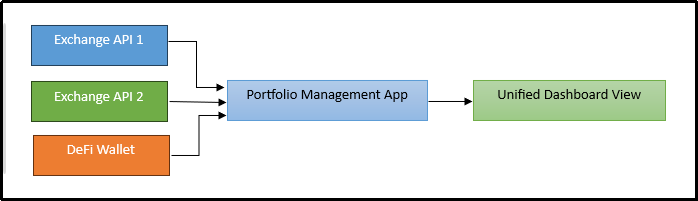
Relying on a single crypto trading platform in India limits structural liquidity access. Professional traders distribute operations across multiple centralized and decentralized liquidity networks. A centralized monitoring app aggregates these distinct pipelines cleanly.
The graphic below shows a simplistic rendition of how a unified monitoring app operates:
Figure
Real-Time Balance Aggregation
Advanced software utilizes secure read-only Application Programming Interfaces (APIs) to import raw data. This connection structure displays multi-exchange token balances on a single screen. Traders gain full visibility without exposing private keys to external networks.
5. Granular Net Profit and Loss Metrics
Basic exchange interfaces fail to deliver deep performance analytics. They often miscalculate holding values by ignoring platform trading commissions. True portfolio health relies on calculating exact net returns over specific holding periods.
Advanced Cost Basis Metrics
Advanced platforms track historical purchase costs using First-In, First-Out (FIFO) formulas. This process calculates localized price deviations despite erratic intraday pricing shifts. Knowing true cost benchmarks helps mitigate unnecessary market exposure.
Analyzing Performance Indicators
- Breaks down individual coin alpha against broader stablecoin index valuations.
- Deducts domestic broker commissions to calculate exact net profitability levels.
- Measures portfolio drawdown metrics during sharp macro-market corrections.
Final Verdict
Evaluating an Indian crypto trading platform requires matching exchange liquidity with advanced portfolio analytics. Your portfolio management app must track 30% tax liabilities, 1% TDS, and multi-exchange API data to protect your capital efficiently.
Optimize Your Digital Wealth Framework
Successful digital asset investing requires transitioning away from fragmented spreadsheet logging. Deploy automated portfolio tools to track your compliance, minimize fees, and protect your investments today.